- Pack Loyalty
- Shared Senses
- Feral Honor
Wolfkin
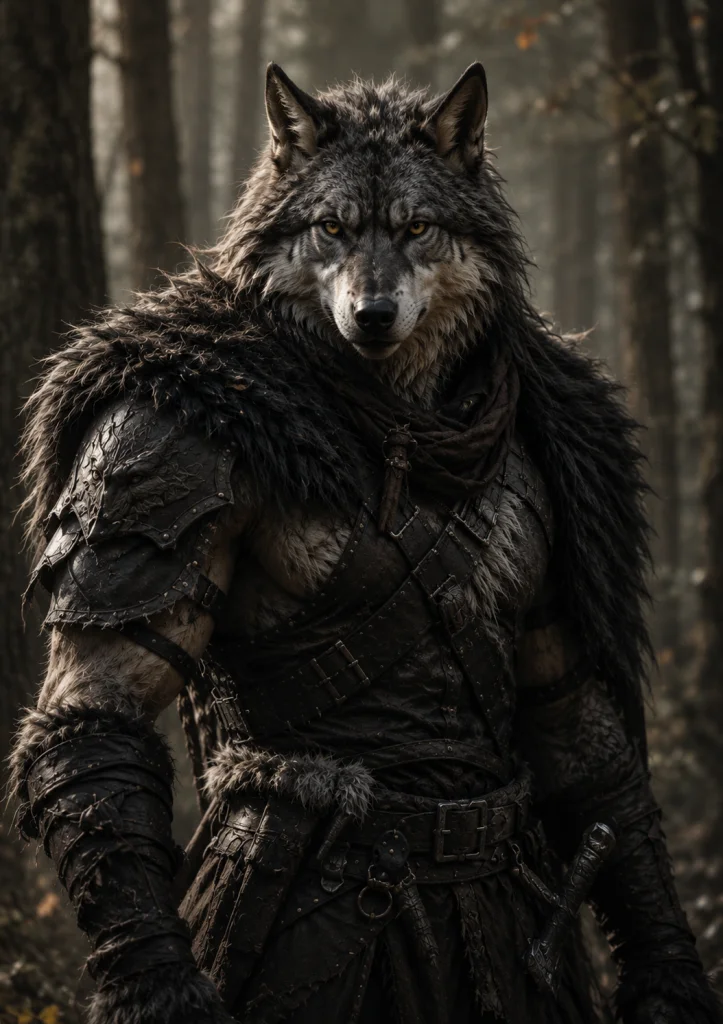
Wolfkin carry the wild authority of the hunt in every movement. Broad-shouldered, furred, sharp-eyed, and built for pursuit, they move on powerful digitigrade legs with a balance that makes rough ground feel like a suggestion. Their ears track every shift in the dark, their tails speak moods before words do, and their jaws remind the overly confident that some smiles come with consequences.
They are at their strongest together. A single Wolfkin is dangerous, but a pack becomes something larger than numbers: shared scent, shared instinct, shared warning, and near-wordless coordination that turns the forest into a net. What one hears, another understands. What one smells, all may answer. It is not strategy in the polite, table-planning sense; it is survival moving through many bodies with one purpose.
Their culture is shaped by loyalty, memory, endurance, and the fierce intimacy of belonging. Clans function as extended families, bound by tradition, shared danger, and the kind of trust that does not need to be spoken every five minutes to prove it still has teeth. Elders are honored not only for age, but for the stories, guidance, scars, and hard-won restraint carried beneath silvering fur.
What makes Wolfkin compelling is the balance between savagery and devotion. They can be brutal in battle, tender with kin, suspicious of outsiders, and unexpectedly charming when someone survives long enough to earn the softer side of the growl. They are not tame, not mindless, and not easily fooled. They are pack, fang, memory, and oath wrapped in fur.
They are at their strongest together. A single Wolfkin is dangerous, but a pack becomes something larger than numbers: shared scent, shared instinct, shared warning, and near-wordless coordination that turns the forest into a net. What one hears, another understands. What one smells, all may answer. It is not strategy in the polite, table-planning sense; it is survival moving through many bodies with one purpose.
Their culture is shaped by loyalty, memory, endurance, and the fierce intimacy of belonging. Clans function as extended families, bound by tradition, shared danger, and the kind of trust that does not need to be spoken every five minutes to prove it still has teeth. Elders are honored not only for age, but for the stories, guidance, scars, and hard-won restraint carried beneath silvering fur.
What makes Wolfkin compelling is the balance between savagery and devotion. They can be brutal in battle, tender with kin, suspicious of outsiders, and unexpectedly charming when someone survives long enough to earn the softer side of the growl. They are not tame, not mindless, and not easily fooled. They are pack, fang, memory, and oath wrapped in fur.