

- Seat of the Crown
- The Eldest House
- Mist Over the Falls
The Crownvale
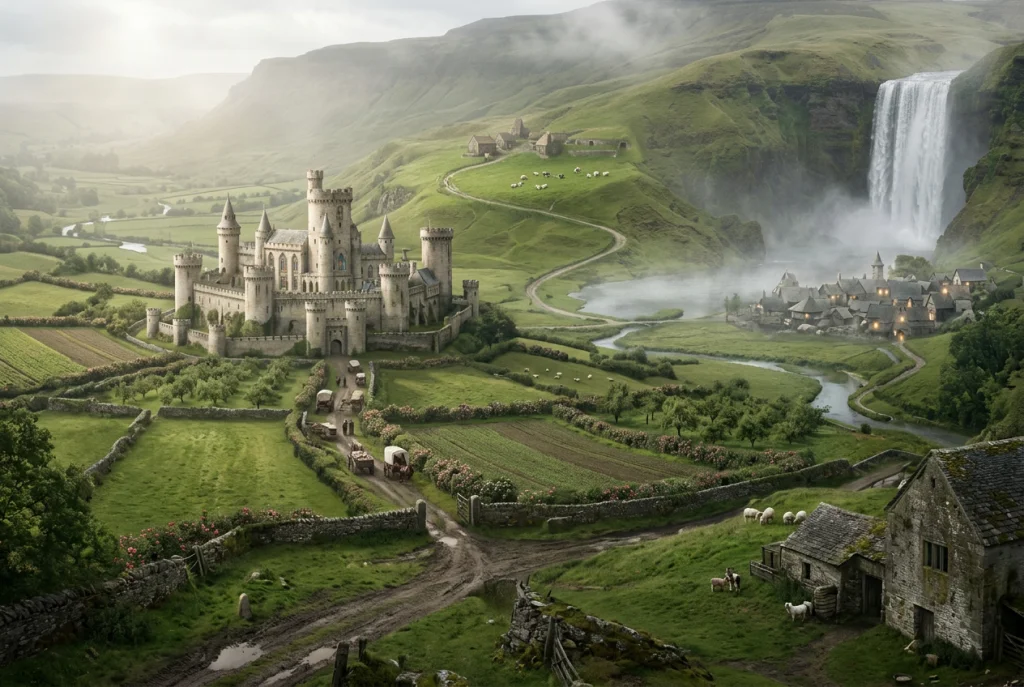
The Crownvale is the quiet green country where the realm keeps its crown. It lies east of the main river: a long valley of patchwork farmland, orchards and rose hedges, held inside a tall ridge that keeps the weather gentle and the wind soft. The royal castle rises out of its fields in towers of pale stone and coloured glass, and market carts still roll right up to its lower gates.
Above the farmland the country climbs into rolling highlands, where rose-hedged Briarbrook keeps its wide greens, its bread ovens and its slow stream. Past Briarbrook the river pours over the lip of a cliff as the Veil, the great falls, and the Waterweight rides the rock beside them down to Veilmere, a lantern-lit lake town wrapped in spray all year. Beyond the lake, on a high shelf where the grass stays green through the driest summer, the herders of Highfold keep their sheep, their goats and their cheese cellars cut into the hillside.
This is the home country of the oldest noble house in the realm. The Greenwells were stewards of these valleys long before the crown came to them, and their name stands first on the noble rolls. They still walk the lanes on foot, know the baker and the miller by name, and settle quarrels over a garden gate. When the crown went looking for a home, it came here.
Life in the Crownvale is gentle, and its people like it that way. Harvests come in, fairs come round, and courtiers buy their bread from the same bakers as the farmhands. Visitors call it the realm's front parlour: tidy, warm, and always kept ready for company.
- Lantern-lit quays
- Spray and slate roofs
- Warm travelers' welcome
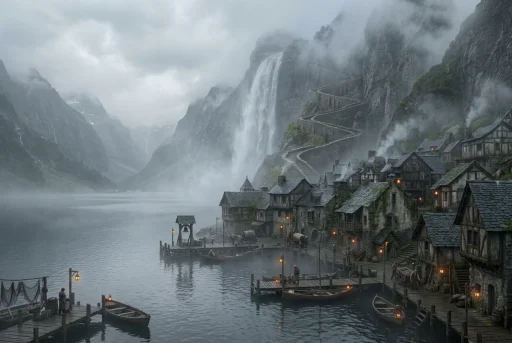
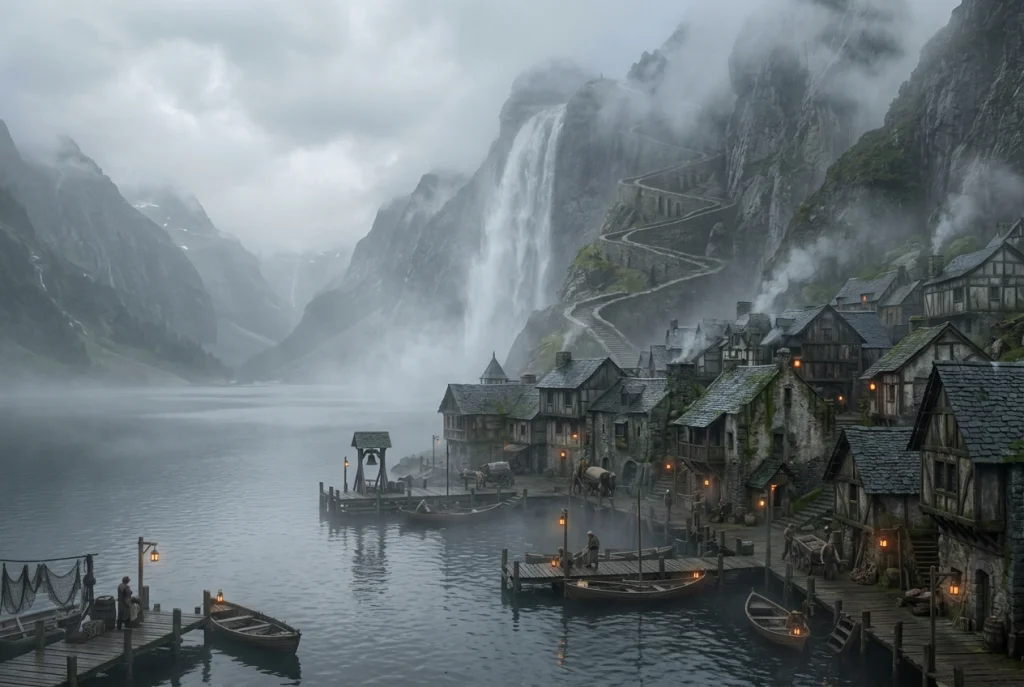
Veilmere sits on a green headland at the bottom of the valley, where the river that drops from Briarbrook's highlands comes down the Veil, the great falls, and runs out into the lake. The falls never stop and neither does their spray. A fine white mist hangs over the north end of town all year, so every roof is slate gone green with moss, every street is a boardwalk on stone posts, and every doorway has a lantern lit at noon. Visitors find it gloomy for about a day. After that they find it soft, quiet and strangely kind, the way rain is kind when you are already wet.
The town lives on the water and on the climb. Flat-bottomed lake boats tie up at the quays below the market with timber, slate, wool and barrels of salt fish from the far shores, and leave with cheese, cider and rosewater brought down from Briarbrook. Between the two stands the Stair, the long switchback path cut into the cliff beside the Veil, and the porters who carry everything up and down it. The porters' yard at the foot of the falls is the busiest ground in Veilmere: loads are weighed and roped there, the guild hall keeps the tally, and beside it stands the foot station of the Waterweight, the water-ballast lift that hauls riders up the cliff for sixty copper bits. A loaded porter takes most of a morning to reach Briarbrook. Most of them say it builds character. None of them say it twice in a row.
At the south end, where the headland narrows to a point, the mist changes. The falls' white spray thins out, and across the water the grey fog of the Forgotten Reach begins, low and still and very patient. The Mistline Inn stands right there on the point, the last lantern of the town and the last door before the fog. A bronze bell hangs on the south quay, and when the Reach fog starts to drift in over the water, somebody rings it until every boat is home.
People in Veilmere are friendly in a damp, unhurried way. They will tell a stranger the price of a room, the time of the next boat and how many silver marks it costs to have a trunk carried up the Stair. They will not tell anyone what lies past the fog, mostly because they do not know, and partly because the innkeeper on the point has asked them not to guess.
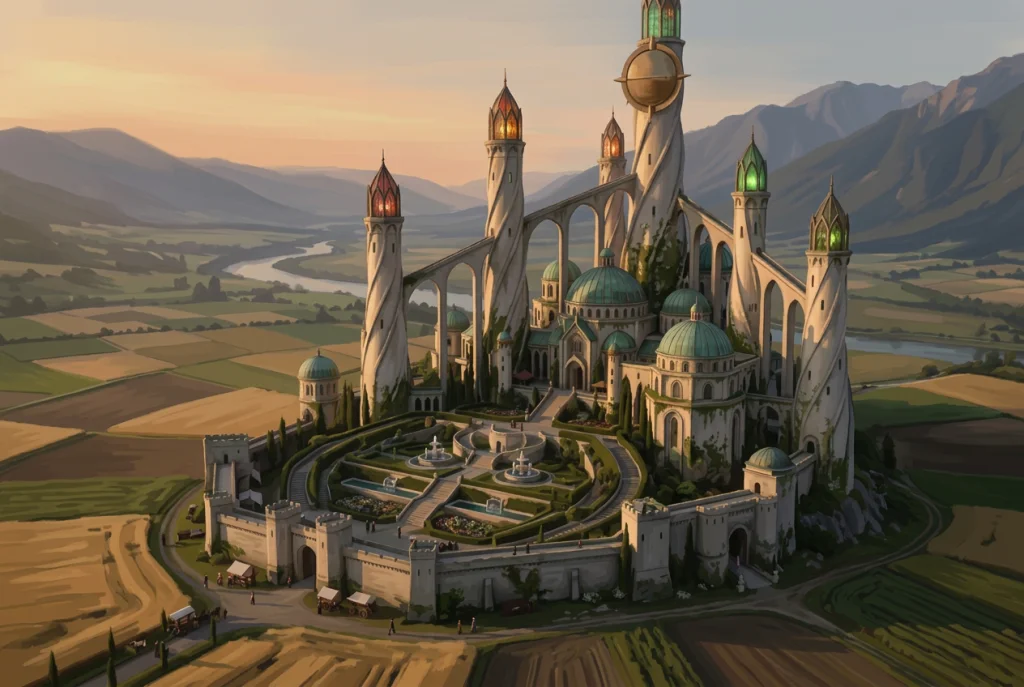
- Royal Seat
- Spiral Towers
- Terraced Fountains
Solspire rises out of the patchwork farmland of a broad river valley, east of the main river and inside the tall ridge, and nothing else in the realm looks like it. Its towers are slender and pale, and they twist as they climb, like wheat stalks turning toward the light, until each one flares open into a crown of coloured glass that throws the sunrise across the fields in red, amber and green. High arched bridges run between the towers, green-copper domes sit among them like upturned bells, and the tallest spire carries a great sun-disc of polished bronze that farmers in the far fields tell the hour by. Below the towers the castle steps down in terraces of gardens and fountains, fed by channels cut from the river, until the last terrace wall gives way to hedgerows and barley. It is the grandest seat in the realm. Market carts still roll right up to the lower gates, the court buys its bread from the same bakers as the farmhands, and on a still evening the whole valley can hear the fountains.
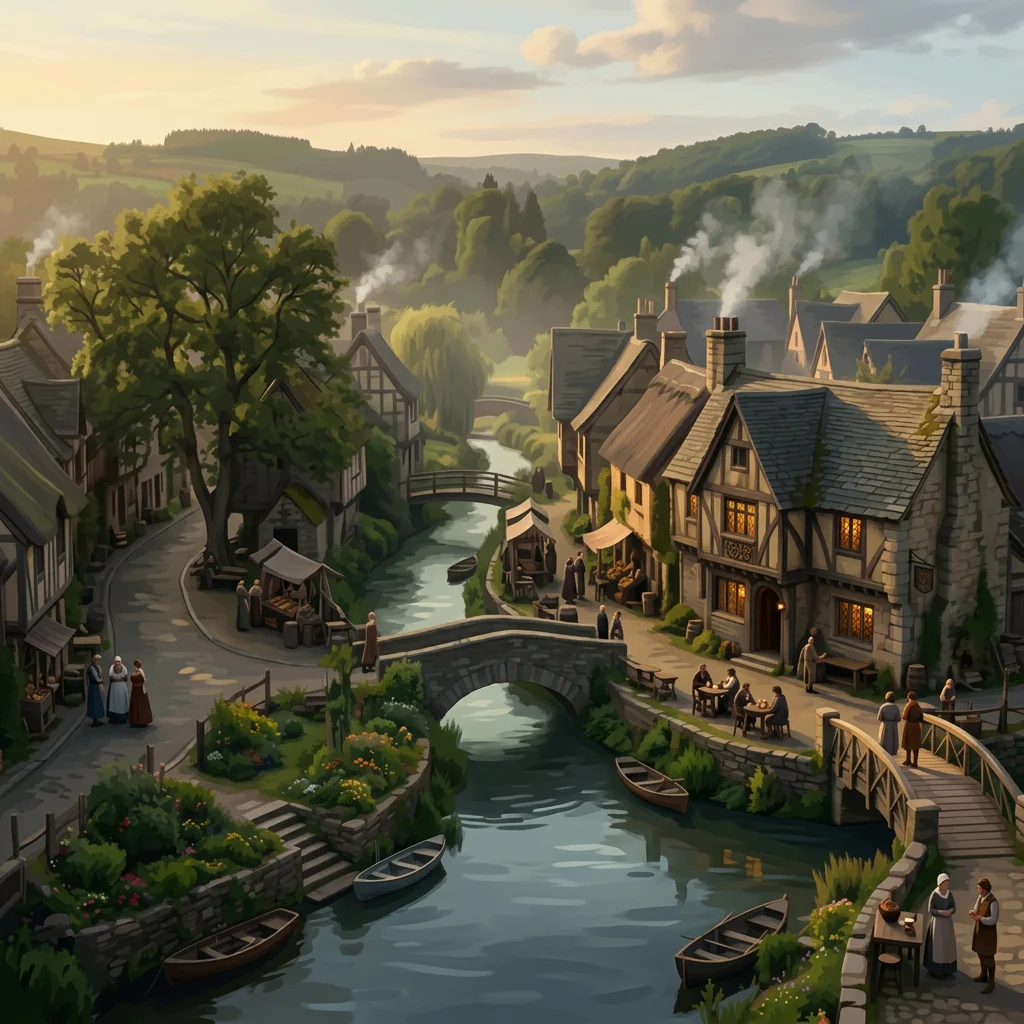
- Warm Bread Gossip
- River Calm Charm
- Pixie Trouble Brewing
Briarbrook is half-timbered cottages under red tile and thatch, flower gardens spilling over low stone walls, and cobbled lanes that cross a little stream on two arched stone bridges. Hedges of wild roses ring the town, and beyond them lie patchwork fields, orchards and rolling green hills. The houses stand well apart, each in its own garden, and between them run wide open greens and commons where children play, washing dries in the sun and nobody is ever in anyone's way. A huge old oak shades the market green, a watermill turns on the stream, a manor's clipped hedges sit at one end and a stone chapel tower at the other. Farmers, bakers, tradesfolk and the oldest noble house in the realm share the same lanes, and nobody hurries them. At the southern edge of town, where the road meets the lip of the falls, stands the slate-roofed wheelhouse of the Waterweight, the lift that lowers travellers down the cliff to Veilmere.
Briarbrook moves with the gentle confidence of a place that has nothing to prove before noon. Cobbled lanes curve beneath old trees, stone ovens breathe warm bread into the air, and the slow river murmurs past gardens, footbridges, and shaded tavern doors. The town is bright without being loud, comfortable without being dull, and full of the sort of neighborly attention that can spot a secret from three streets away.
Its charm lies in how easily rank seems to loosen here. The nobles of Briarbrook walk its streets on foot instead of riding through them. They stop at garden gates, ask after new babies and sore knees, and know the baker, the miller and the miller's children by name. Lady Elara Greenwell is the best loved of them all: she can rarely cross the market green without being stopped three times, and she never seems to mind. Fine sleeves brush against work aprons in the market, noble laughter spills beside common gossip, and tavern tables have a way of making titles feel temporarily negotiable. Tradition still matters, but it wears softer boots than in sterner places, allowing pride, mistakes, flirtation, and second chances to mingle beneath the same low rafters.
In Briarbrook the quiet places often reveal the loudest truths. It is where bruised ambition can become discipline, where ridiculous schemes can hide real stakes, and where comfort makes it harder to pretend pain is noble. Beneath the bread-sweet air and easy smiles, the town keeps its whispers close — not cruelly, just carefully.