


- A Fool in the Square
- Laughing Too Early
- The Last Punch Line
The Joke Before the Fall
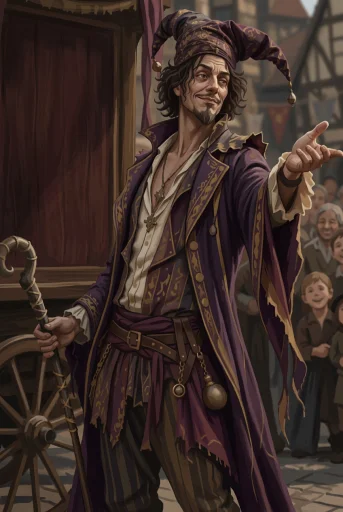
He arrives like a mistake with excellent timing: bells jingling, robes dragging, fingers stained with ink, glitter, and whatever poor decision passed for breakfast. Most adults know better than to take him seriously, which is exactly why they keep listening. His tricks fail loudly, his jokes wander off halfway through, and his laughter always seems to arrive one breath before the room understands why.
Beneath the ruined magic and theatrical nonsense is a mind that catches fragments of what should not yet be known. He wraps prophecy in punchlines because straight truth makes people flinch, and frightened people rarely hear the warning before it grows teeth. A riddle, a pratfall, a ridiculous bow — these are the little doors he leaves open for survival to slip through.
He is warm enough to charm children, sharp enough to unsettle nobles, and lonely enough to make every burst of applause feel like shelter from the silence waiting after midnight. Whether fool, prophet, menace, or mercy depends on when the bells ring — and whether anyone is wise enough to laugh before running.
- Chaos in Velvet
- Prophecy in Punchlines
- Laughter Before Ruin
- Harvest Crossroads
- Saltfair Market Days
- Granaries Worth Guarding
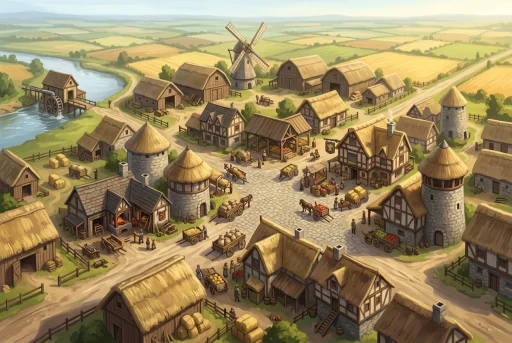
Sheafcross is thatched barns, stone granaries and half-timbered houses built right on top of the place where the farm roads of the Fertile Fields meet. The roads do not go around the town; they become it. Both run straight through as its main streets, lined with carters' yards, a smithy, a cooper's shed, feed stores and taverns, and they meet at the market square, a little west of centre, where open-sided market halls, grain halls and a coaching inn crowd around the cobbles. A single watermill turns on the river bend at the west edge, a windmill stands among the barns to the north, round granaries are scattered all through the town like patient giants, and past the last fence the patchwork fields roll off in every direction.
Everything in Sheafcross is sold by the cartload. Grain, hay, onions, apples, cheese, wool, eggs, piglets and opinions all change hands at the crossing, and the town measures its days by what is coming in on the roads. Millwheel starts the week with the mills grinding before dawn. Fullpurse is wage day, when every hired hand in the valley is paid at the market halls and the taverns are full by dusk. Saltfair is market day, when carts park three deep along both roads and nobody can cross the street without buying something.
The town is proud, loud and practical. Its people judge each other by the weight of a sack and the straightness of a furrow, use the weather as a greeting, and trust a handshake over a contract until the handshake goes wrong. Its grain goes downriver to the markets of Three Rivers, its cheese and cider go north to the inns of Briarbrook, and its carters know every rut in between.
Under the bustle runs the Heartland's newer unease. Carts arrive a sack short with nobody to blame, a granary empties with its lock still shut, and odd lights drift over the far fields that the carters have agreed not to mention before supper.