


- Polished Ambition
- Borrowed Elegance
- Patient Leverage
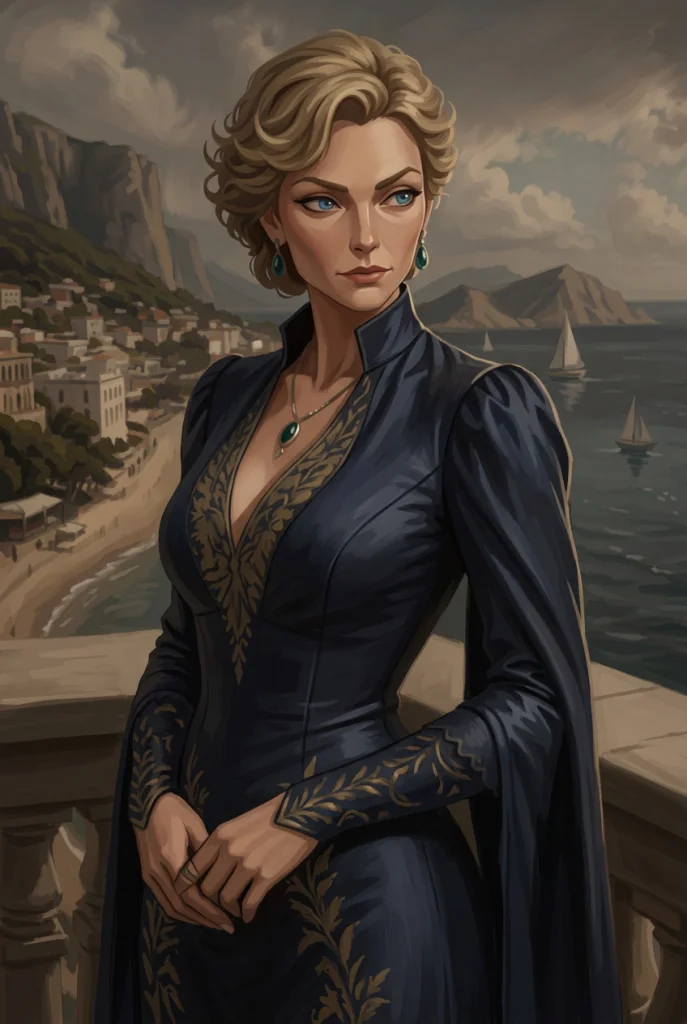
Evelina Seacrest
Alignment: True Neutral
She grew up in the fish-salting lanes behind the Ashmoor docks and married, by sharpness and some luck, into the next best thing to nobility: the Herald of the coast, a respected man welcome at every noble table and rich at none of them. She has spent twenty years learning to sit at those tables as if she belonged there, and nearly all of the household's money learning to dress the part. The bills come to a house a little too small for its silver. She pays them with charm, credit and patience.
What Evelina wants is simple, and she has never pretended otherwise: a title of her own, written in the Rolls where no one can ever take it back. The problem has always been her husband. Draven would not bend the Rolls for anyone, not even for her. And now that his memory is failing, he has become an embarrassment, a danger and, since he wandered off into the fog with his satchel, a missing man she very publicly wants found.
Speak with her and she will be gracious, precise and faintly bored. Mention her husband and she will be all wifely concern. Mention his satchel, and for one unguarded moment she will look very interested indeed.
The search runs through parlors, card tables, chapel steps and the back doors of the harbor's better houses. Everyone is sympathetic. Everyone has a theory. A cousin suggests she let him go in peace. A magistrate offers help with too many conditions. A housekeeper hints that the old man was carrying something valuable. The player works as her messenger, escort and second pair of eyes, and slowly learns that she wants him back very badly, though perhaps not only for his sake. Whether this is a rescue, a hunt, or something in between is the player's to find out.
- Calling Cards and Cold Tea
- A Missing Husband
- Everyone Wants Something
- Salt Worn Secrets
- Guarded Docks
- Forest Shadows
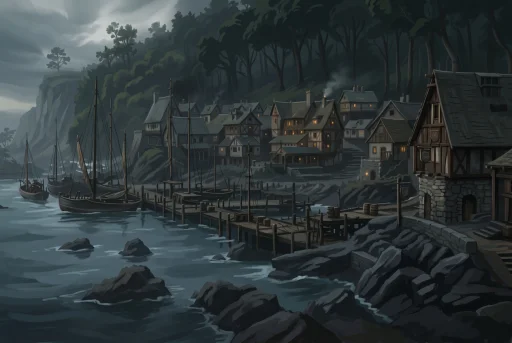
Ashmoor is grey timber and stone under dark slate and shingle: a few hundred narrow houses squeezed between a pine-black hill and a curving tan beach. A timber palisade with a watch-gate guards the forest track, and a long stone breakwater and spindly jetties reach into the surf, hung with nets and fish-drying racks. The harbor-master's stone tower watches the water, a smokehouse leaks thin smoke, and the tavern stands on stilts at the end of a jetty. Fishers, dockhands and sailors who never name their last port live here.
Ashmoor sits where gray water beats against a rocky shore and the wind carries more warnings than welcome. Weathered docks jut into the surf, slick with salt and old rain, while low buildings huddle near the water as if trying not to be noticed. The air smells of brine, wet rope, fish smoke, damp timber, and the kind of business that prefers witnesses with short memories.
Trade comes through quietly here. Ships arrive with cargo that is rarely discussed too loudly, coin passes beneath folded cloth, and conversations shrink into murmurs when unfamiliar boots hit the planks. The town survives by discretion, suspicion, and the practiced art of looking away at exactly the right moment. Charming, really, if one enjoys being judged by three windows and a fisherman before finishing a sentence.
Behind the town, the forest presses close with tangled roots, misted paths, and a silence that feels just as guarded as the streets. Ashmoor matters because it sits between two kinds of danger: the sea that takes without warning, and the woods that watch without blinking. Secrets wash ashore here, but trust rarely does.
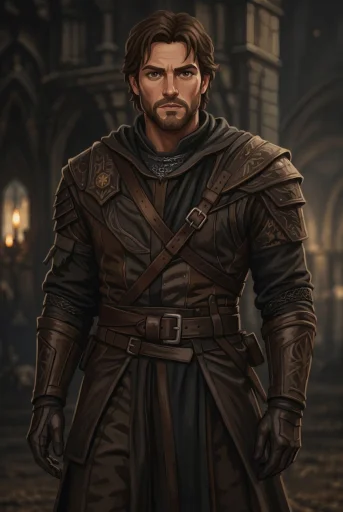
Human
Humans arrive in the world without obvious advantages, which seems rude until they start turning that lack into everybody else’s scheduling problem. They build shelters where storms insist they should not, raise banners over places that keep trying to kill them, and make tools from whatever is close enough to grab. Give them a broken road, a bad season, and one questionable plan, and somehow there is a village there by spring. Annoying? Absolutely. Effective? Tragically, yes.
Their lives burn quickly compared to longer-lived peoples, and that urgency shapes everything they touch. They chase love, power, safety, glory, revenge, comfort, and terrible ideas with the same dangerous momentum. A human court can become a battlefield with better clothing, while a frontier camp can turn into a kingdom if enough stubborn fools agree to keep hammering posts into the mud. They do not always know when to stop, which is charming right up until it becomes a siege.
What makes humans significant is not perfection, purity, or some grand destiny conveniently gift-wrapped by the heavens. It is variety under pressure. They can be farmers, soldiers, rulers, wanderers, cowards, lovers, tyrants, protectors, liars, and heroes before lunch if the day is especially rude. They are ordinary in the way flint is ordinary: dull in the hand until struck, then suddenly full of fire.
- Stubborn Survivors
- Endless Adaptation
- Ordinary Trouble