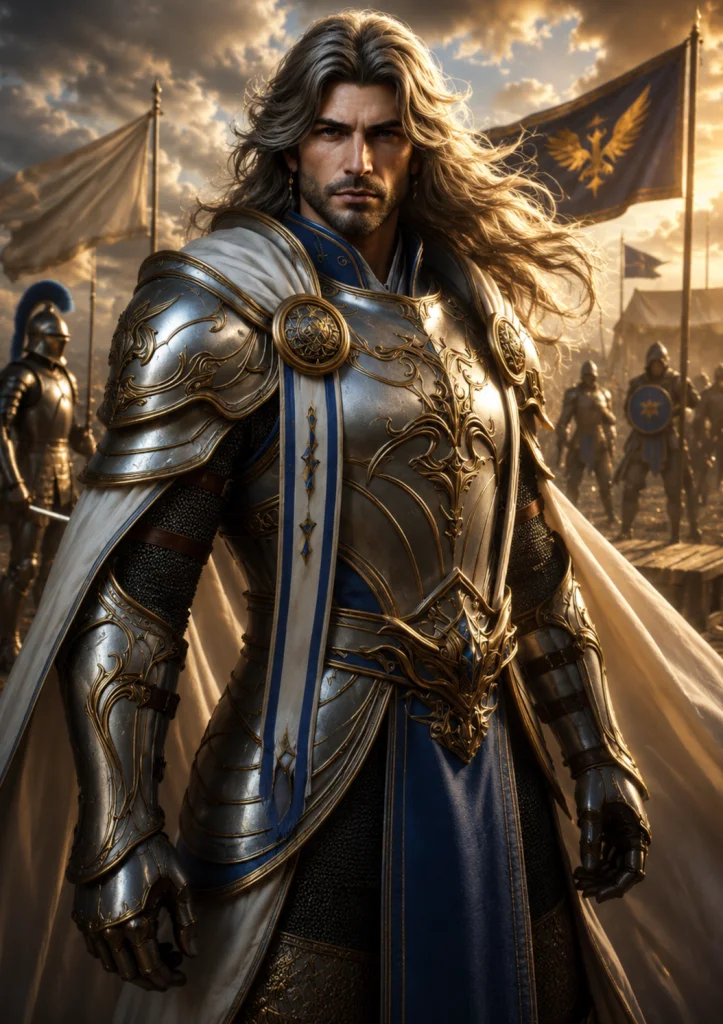
- Blunt Commander
- Hard Mercy
- Political Disgust
Master-at-Arms Daelen Virell
Alignment: Lawful Neutral
At the war camp, his rank places him close enough to politics to understand their shape and far enough from comfort to despise them. He knows when to hold his tongue, when to speak like a blade through silk, and when a negotiation is only a battlefield pretending to have chairs. That skill makes him useful to those above him, even when his honesty makes them grind their teeth.
In The Gilded Rack, he stands as an antagonist not because he enjoys suffering, but because he believes order survives through hard decisions and harder people. The chamber’s polished cruelty disgusts him more than he admits, yet he remains bound to command, duty, and the ugly necessity of keeping the army intact. His conflict is not softness against strength, but discipline against corruption wearing the same uniform.
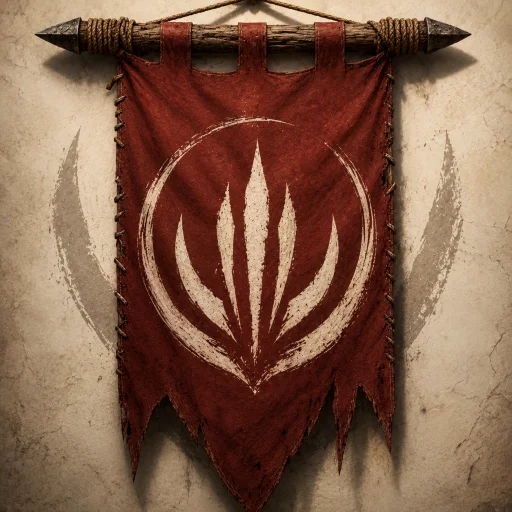
The war camp is a city made of canvas, steel, mud, prayer, and exhaustion. Banners snap over training yards, supply rows, infirmary tents, command tables, and guarded paths where every soldier knows which questions not to ask too loudly. Discipline keeps the camp alive, but discipline is starting to look too much like silence.
At the center of the strain stands a commander who believes weakness kills faster than enemy blades. He drills recruits until excuses fall away, corrects officers with the same blunt force he uses on rookies, and treats politics like a disease that somehow learned to wear medals. He can play the game when rank demands it, but he hates every perfumed second of it.
The Line That Holds follows a conflict contained entirely within the army’s own war camp, where orders, rumors, and fear move faster than messengers. While darker ceremonies unfold elsewhere beneath righteous banners, this story watches the surrounding machinery: the soldiers ordered to stand guard, the recruits forced to harden too quickly, and the officers trying to decide whether truth is worth the damage it might cause.
The danger is not an enemy charge. It is collapse from within. If the commander holds the line too tightly, he may become another tool of the rot he despises. If he loosens it, the camp may break before dawn.
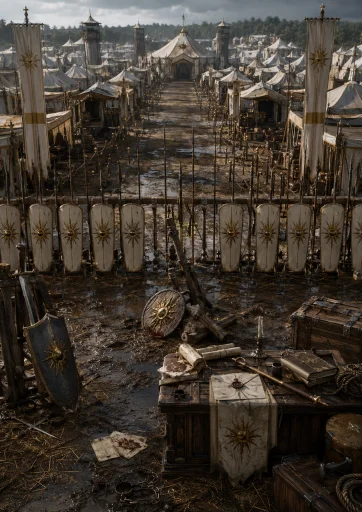
- Camp Pressure
- Hard Discipline
- Rotten Command
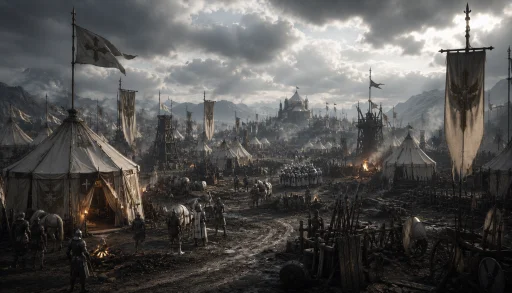
- Holy War Machine
- Heavy Military
- Spoils and Silence
The War Camp sprawls across scorched ground in ordered rows of canvas, timber, steel, and watchfires. Banners snap in the wind above ranks of soldiers, supply wagons, weapon racks, command tents, and training yards where drills continue long after sunset. The air smells of smoke, oiled leather, hot iron, horse sweat, and old blood scrubbed poorly from places everyone pretends not to notice.
This is not a camp built for rest. It is a moving engine of discipline, faith, conquest, and command, where every hammer strike, shouted order, sharpened blade, and polished breastplate feeds the next march. Soldiers move with practiced obedience, armorers work beneath low flames, scouts come and go through guarded paths, and officers speak in clipped voices over maps marked by decisions that will ruin lives far from the firelight.
The War Camp matters because it shows the cost beneath holy certainty. To some, it is protection given structure; to others, it is violence dressed in clean banners and righteous language. Spoils lie tucked beneath canvas, prisoners are watched from shadowed edges, and every road leading away from the camp feels like a question no one is permitted to ask aloud.
Human
Humans arrive in the world without obvious advantages, which seems rude until they start turning that lack into everybody else’s scheduling problem. They build shelters where storms insist they should not, raise banners over places that keep trying to kill them, and make tools from whatever is close enough to grab. Give them a broken road, a bad season, and one questionable plan, and somehow there is a village there by spring. Annoying? Absolutely. Effective? Tragically, yes.
Their lives burn quickly compared to longer-lived peoples, and that urgency shapes everything they touch. They chase love, power, safety, glory, revenge, comfort, and terrible ideas with the same dangerous momentum. A human court can become a battlefield with better clothing, while a frontier camp can turn into a kingdom if enough stubborn fools agree to keep hammering posts into the mud. They do not always know when to stop, which is charming right up until it becomes a siege.
What makes humans significant is not perfection, purity, or some grand destiny conveniently gift-wrapped by the heavens. It is variety under pressure. They can be farmers, soldiers, rulers, wanderers, cowards, lovers, tyrants, protectors, liars, and heroes before lunch if the day is especially rude. They are ordinary in the way flint is ordinary: dull in the hand until struck, then suddenly full of fire.
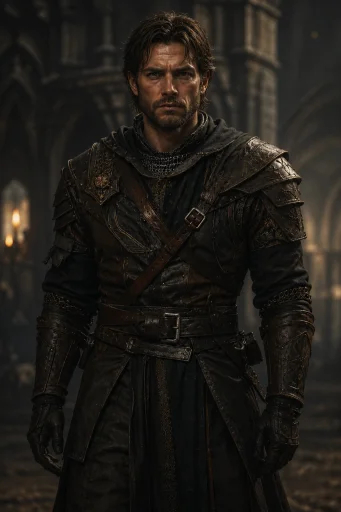
- Stubborn Survivors
- Endless Adaptation
- Ordinary Trouble